

Playwriting (part I)
A letter on the craft, written to the cast of my one-act comedy

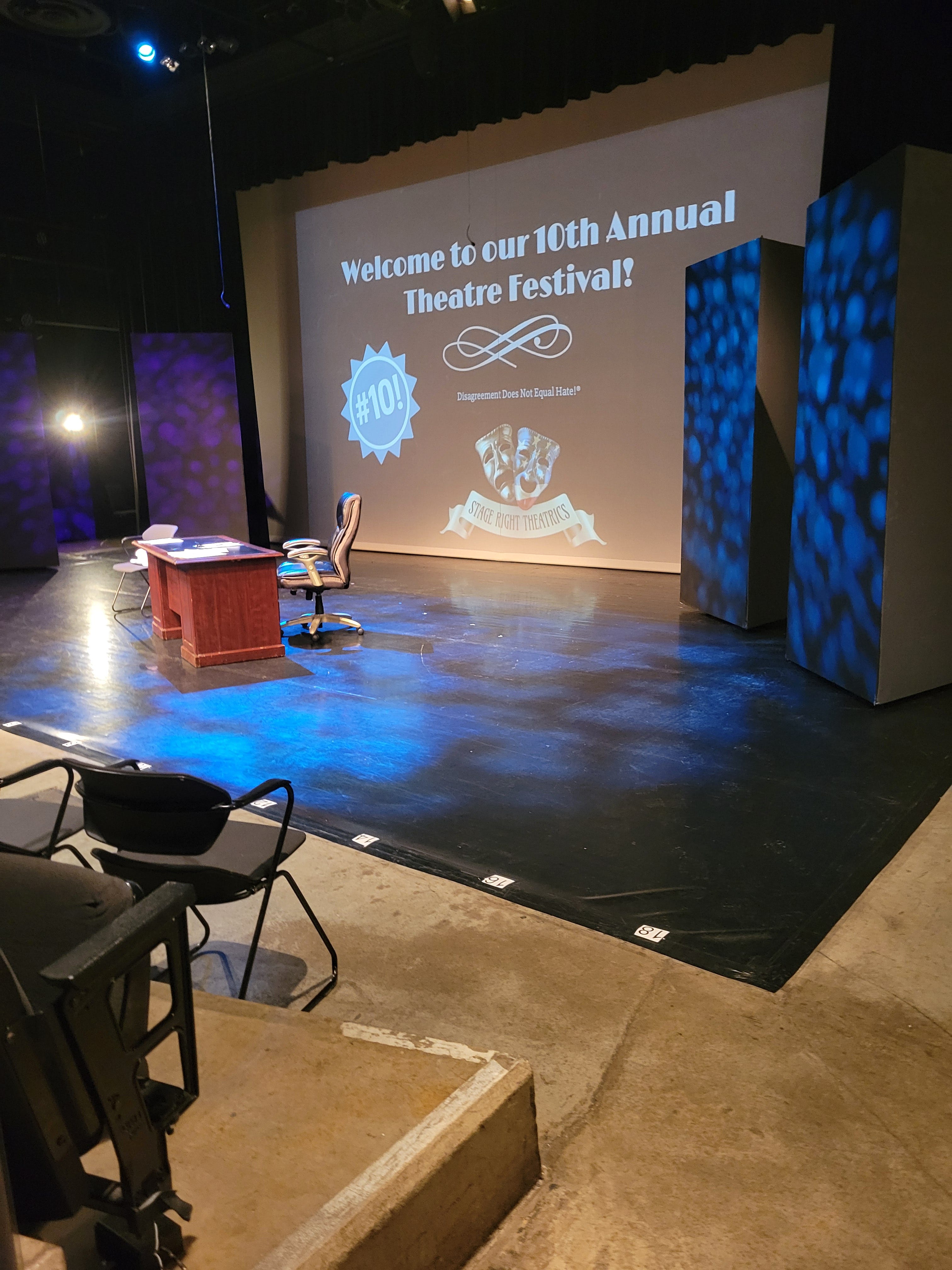
Having your play performed is a huge honor. On the flip side, and while much easier than pulling seven figures together to film a feature, staging someone’s play for a live audience is no small feat. Taking someone’s words all the way through casting, rehearsing, venue, and then tech, props, and costumes takes time, money, and things going wrong.
If the play is new and daring and not, let’s say, a beloved musical once staged in New York, there’s usually no money in return.
Having done all that (and having walked onstage myself when an actor flaked out last minute), I’m all the more grateful when I get to just be the playwright, the guy whose words are being cast, rehearsed, cue-to-cued, and so on, with no involvement besides having written them.
A few weeks ago, I had that honor.
I took the occasion to fly out to snowy-white Ohio, for a production of my one-act ‘All Packed’ by Robert Cooperman’s Stage Right Theatrics. My one act comedy—a Covid lockdown force shortened to a lively, twenty-five minutes—appeared in a lineup of four plays. All four were selected and staged as part of Stage Right’s tenth annual new theater festival.
Before I get into that, let me point out that Robert and his theater company are a diamond in the rough, American theater scene-wise. With no exceptions, Stage Right Theatrics is the only theater company founded as an alternative to the woke left’s predictable, cultural-intellectual monopoly on stages throughout the country.
Regional theaters, arts centers, college theater departments—nearly all lean left.
For about a decade, and with the standard fare being lesser-known plays by American greats like Tennessee Williams, Stage Right has been one of the few companies open to* (simply open, not insistent upon) new plays written by conservatives.
*For the record, New Threads Theater Company in Tennessee is another, and The Base in London is worth checking out.
I’d be remiss if I didn’t clamber up the ol’ soapbox and say this. Broadly speaking, conservatives and Christian-conservatives who want to influence the culture long term should be going all in on the arts.
All in.
For now, that means rushing to support arts producers like Robert Cooperman, individuals involved in their local arts community (I learned in a talkback after the show that Robert pays his actors) and at the same time, mocked and shunned for not towing the political-culture line.
Earlier this month, the Daily Wire did a splendid profile on Stage Right and its history. As things go, I hope you and I will hear more about them. To echo former Broadway star turned freethinking influencer Clifton Duncan, we’ve got enough podcasts. Enough hot takes. Enough outrage.
Long-term, ideas sink in through the arts, and live theater is highly potent.
Word on the Pond
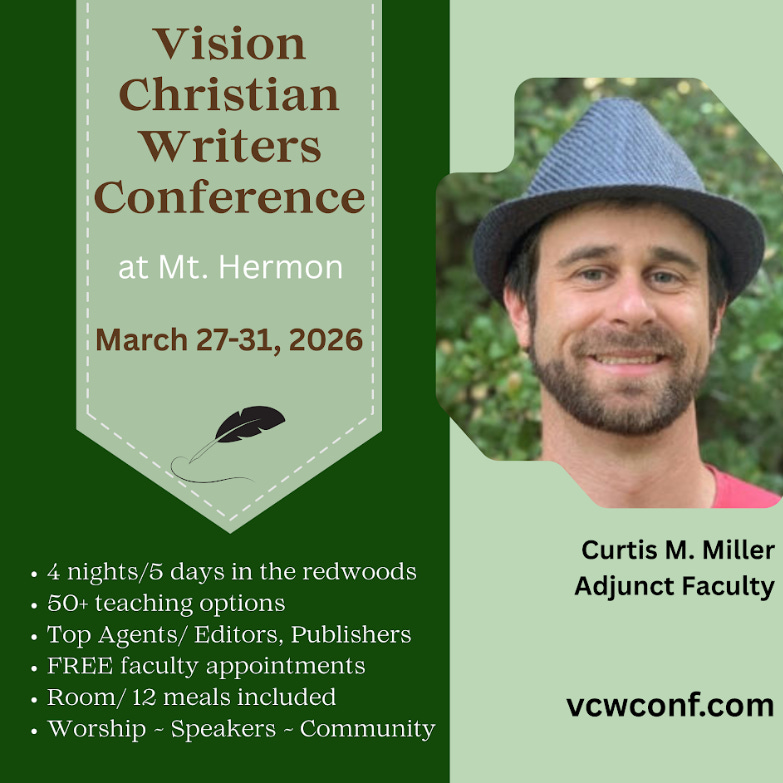
Finally, and on another side of this, I’m throwing some support to live theater by teaching a playwriting workshop at the upcoming Vision Christian Writer’s Conference in Santa Cruz, California.
If you’re looking at Christian publishing as a place to network, pitch, and or get published, check Vision out—you can’t beat meeting editors and agents face to face in and among the redwoods.
As of now, you can still attend: it’s March 27th to 31st and registration is open until the March 20th.
With that, consider this essay part I of II (or maybe III…) on playwriting 101. A series that will likely dovetail with what I’ll be teaching in Santa Cruz in less than a month.
To bring things full circle, what prompted this playwriting focus was nothing other than seeing my play performed in Ohio. After seeing both Friday and Saturday night’s performance, I had a splendid time connecting with the two cast members (a husband and wife acting couple)… and one of them asked me about playwriting playwriting. After flying home and gathering my thoughts, I sent them both an email, an attempt to summarize the absolute basics of what a play is and how to start writing one.
That email, with some embellishment, is what I’ve published here.
On a final note, I’ve had a few people reach out to me about playwriting over the last year. So if the subject interests you, or if you’d like to try your hand at it with feedback and consultation, that’s something we can discuss.
Reach out at cmillcontent@gmail.com.

A Letter to My Cast on Playwriting
A.J. and Robyn,
I hope Sunday’s matinee went well! I wanted to reach out here and follow up on two topics Robyn mentioned after Saturday’s show:
1) Playwriting -- A.J., you probably have some perspective on this as a director, so feel free to jump in.
and 2) being a Christian in the secular theater world.
Topic one is fresh on my mind because I’m preparing to teach a workshop on playwriting at a conference fairly soon, so I’ll start with that one.
Again, thank you both for the memorable performance. You gave my play everything you had; it was such a treat to see it live and then meet both of you. If I can get a play in Robert’s festival next year and make it out to Ohio, I hope to see you there. With that, here’s some quick notes on playwriting basics—a few concepts that I, for one, have found helpful again and again.
Let’s get the fire started.

Three Questions
Robyn — it sounds like you’re writing a play, and you mentioned David Mamet. Not sure where you are with your project, but I will say this: for all his vulgarity, Mamet’s a great resource for playwriting basics.
His shortcut to framing conventional scenes and then filling them out with dialogue (granted there are many non-conventional kinds of scenes and dialogue) is answering three questions:
A. Who wants what from whom?
B. What happens if they don’t get it?
C. Why now?
Sticking to these questions is one way of keeping your scene, act, or entire play on target—and interesting to watch—by understanding who takes action. As you both know from acting, characters taking action (angling, scheming, confronting, maneuvering, physically fighting) to get what they want are interesting. A crude paraphrase of Aristotle is that characters are action; people are what they do, in relation to what they want. Words run wild—we joke, flatter, and smooth over all day long, but when we take concrete steps to get what we want, the true colors come out.
“It wasn’t luck. It was skill. You want to throw that away, John? You want to throw that away?”
“It isn’t me.”
“…it isn’t you? Who is it? Who is this I’m talking to? I need the leads…”
“After the thirtieth.”
“Bull— the thirtieth, I don’t get on the board the thirtieth, they’re going to can my ass. I need the leads. I need them now. Or I’m gone, and you’re going to miss me John, I swear to you.”
-David Mamet
This exchange is from the famous opening of Glengarry Glen Ross1, Mamet’s Pulitzer-winning cuss fest with real estate hucksters locked in a war of survival. Without knowing too much about that scene (or even who’s talking…) you can watch all three questions at work, and I’m guessing you’re piqued at the very least.
Mamet’s point cuts to the fact that we are needy beings. A paycheck, a spare tire, a confession, our share of Dad’s inheritance, control over a glass of water2—at various times we need various things on a primal level to survive, move forward, and vindicate ourselves and others. Drama is all about primal needs pushed to the max, which makes the question who wants what from whom? universal.
A sidenote on characters taking action: action could be dialogue, but it doesn’t have to be. Echoing onstage from actual mouths, dialogue certainly serves a play’s actions, often more so than in a movie—but it’s not always necessary. Theater, like dance, and like the group rituals it sprang from, is a physical art form. The audience only knows what it hears or sees, and there are scenes and in some cases whole productions where seeing is everything.
One more note on question A, make your characters work for it.
Onstage, onscreen, or even on the page, the harder a character works for something, and the more obstacles they face with limited time to overcome them, the better. A burning want plus obstacles plus not enough time amounts to great tension, and tension is like hitting the gas pedal. When obstacles come up, a character might change what he wants or how he’s going about getting what he wants… and either will work as long as he’s trying ever harder, against diminishing odds, to get it.
Take my play, ‘All Packed,’ for example,3 a farce in which two college lovebirds find themselves in different sides of a 2020 pandemic lockdown order.
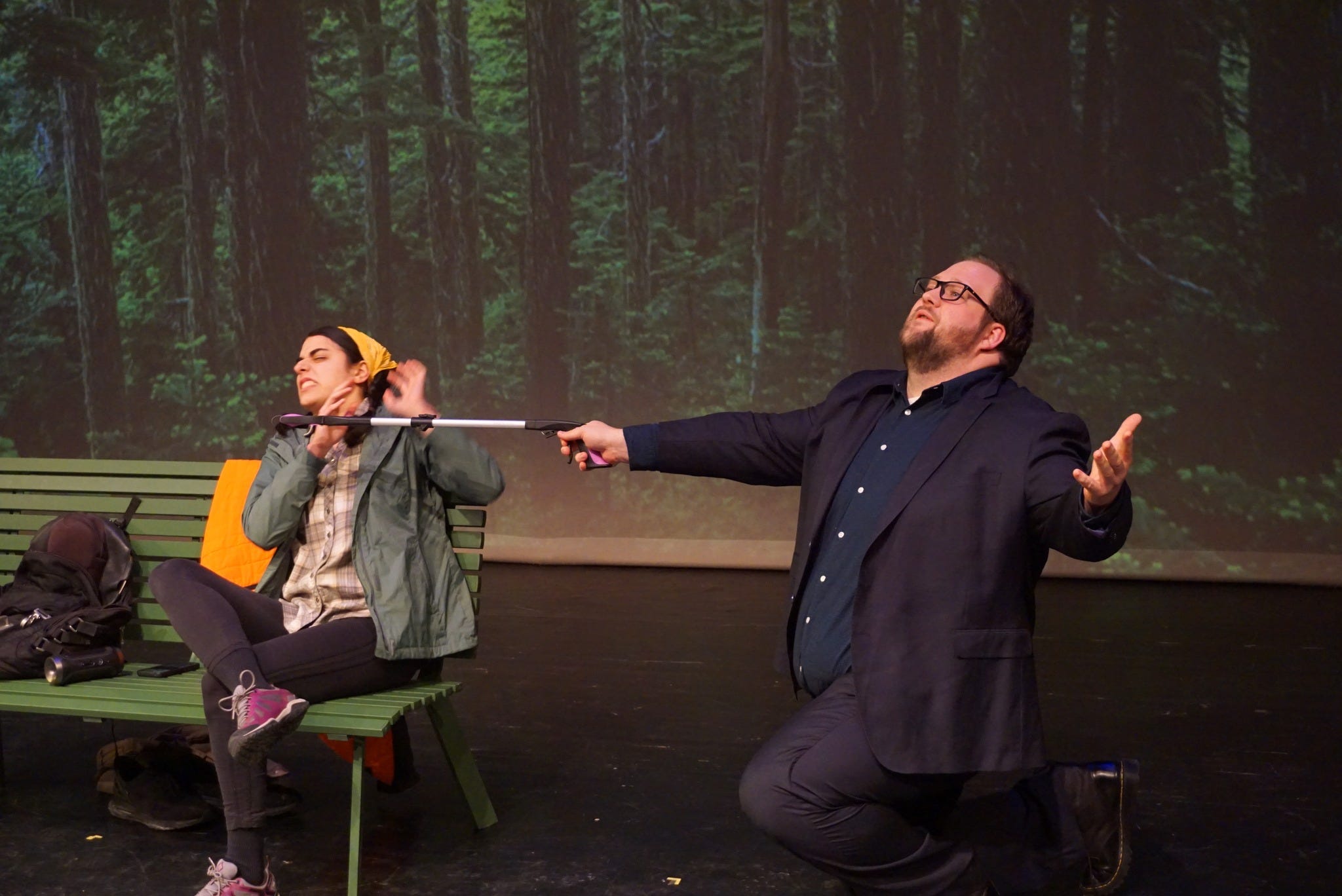
Applying Mamet’s first question who wants what from whom? here’s what we’ve got:
-Hodge wants a ‘Yes’ from Sierra.
-Sierra wants to say ‘Yes’ (lucky Hodge) ...and from Hodge, she wants chivalry and panache—a marriage proposal worth treasuring.
Enter the lockdown order.
-Now Hodge wants Sierra to say ‘Yes’ while he follows strict CDC guidelines
-Now Sierra wants Hodge to (in her view) come to his senses and stop following them.
So they both want something from each other badly (proposals, by the way, are inherently dramatic). Now, as I’ve heard the old-timers say, we are cooking with gas.
If you’ve followed this concept so far, you might have some ideas bubbling up. Start them off right by drilling down to two characters who each want something from the other. Onstage, in front of an audience, with only words and body movements to work with, that’s plenty.
What and Why
Questions B (what happens if they don’t get it?) and question C (why now?) are another way of asking ‘what’s at stake?’
Knowing what’s at stake is important; it anchors the play by defining consequences, a courses of action and / or a timeframe for the audience. High stakes also lend purpose and gravitas to characters who want something—as much of a glimpse at something serious at stake makes us pay attention.
Again, another sidenote: plays that deal thoughtfully with clearly defined stakes and consequences tend to ‘arrive late’ or begin when a clock is already ticking. The stakes, as we’ll see in a few examples, may not be revealed instantly, but as the story starts, they already hang in the balance. When the stakes are finally lowered (lost, or won) with the actions being played out, the play is over… and we get to ‘leave early’ without too much in the way of resolution.
In arriving late and leaving early, stage plays are particularly lean—actions only, and then we’re done.
Here’s two examples of high stakes that start with a ticking clock:
-At the start of Oedipus Rex the gods have stricken Thebes with a plague, so the King is motivated to find out why, make amends for whoever has offended them, and stop the carnage fast.
In The Crucible more and more people residents of Salem are being accused of witchcraft and thrown in jail... so John Proctor had better speak up before they all hang.
When Oedipus / Proctor succeed or (if you know those plays... fail to), the tension / action / play is over.
If the stakes are not life-and-death, then serious consequences must hang in the balance. In one way or another, the world of the play/characters will not be the same after whatever happens.
In ‘All Packed’ there isn’t exactly a ticking clock... but the proposal raises the stakes for Hodge and Sierra’s relationship.
However it goes, a marriage proposal is usually a point of no return.
The lockdown order that pits them against each other raises the stakes higher—if CDC compliant Hodge can’t win skeptical and disbelieving Sierra over to his side or vice versa, there’s no ‘yes’ and it’s all over. As Sierra senses, obeying a lockdown order or not is no small negotiation; it’s a harbinger of how other things will go throughout their life/marriage together should she say ‘yes.’
So again, with Hodge and his plastic grabber pressing the question—and with Sierra now not wanting to hear it—we’ve got a strong, stage worthy ‘why now?’
He just proposed.
What’s she going to say?
In short, and if you’re starting where you probably should with a ten minute or one act drama, those three questions should get you off the starting block. I’ve found, having written my fair share of bad plays, that answering them fully and completely for two single characters is harder than you think.
But to quote Chesterton “Anything worth doing is worth doing badly at first.”
I’ve more to say on actions, pacing, and plot structure, but I think this is a good stopping point.
TLDR... I hope this helps and that it’s not all super obvious. A lot of the stuff you both know from acting applies to playwriting, which should give you a head start. If I can shorten this to one takeaway, it’s this—unlike fiction, film, video games, etc. writing for the stage is restricted because theater is physical. Characters walk on, say the words, and walk off, with people in seats watching them. When you’re writing a play, you can’t lose sight of the fact that the audience can’t see inside anyone’s head. All they know, at the rate at which you the playwright reveal it to them, is what those onstage say and do.
If you look closely, people are never boring; like characters onstage they show their colors by trying to get something they want.
A Last Word:
Read as many plays as you can!
A few that demonstrate questions A, B, and C effectively are Doubt by J.P. Shanley, The Glass Menagerie by Tennessee Williams, Proof by David Auburn, of course Glengarry Glen Ross …and the four major works of Arthur Miller. Classics like Antigone, Oedipus, Macbeth, Hamlet, The Merchant of Venice, and Measure for Measure—to name a few—all have a strong sense of want and urgency.
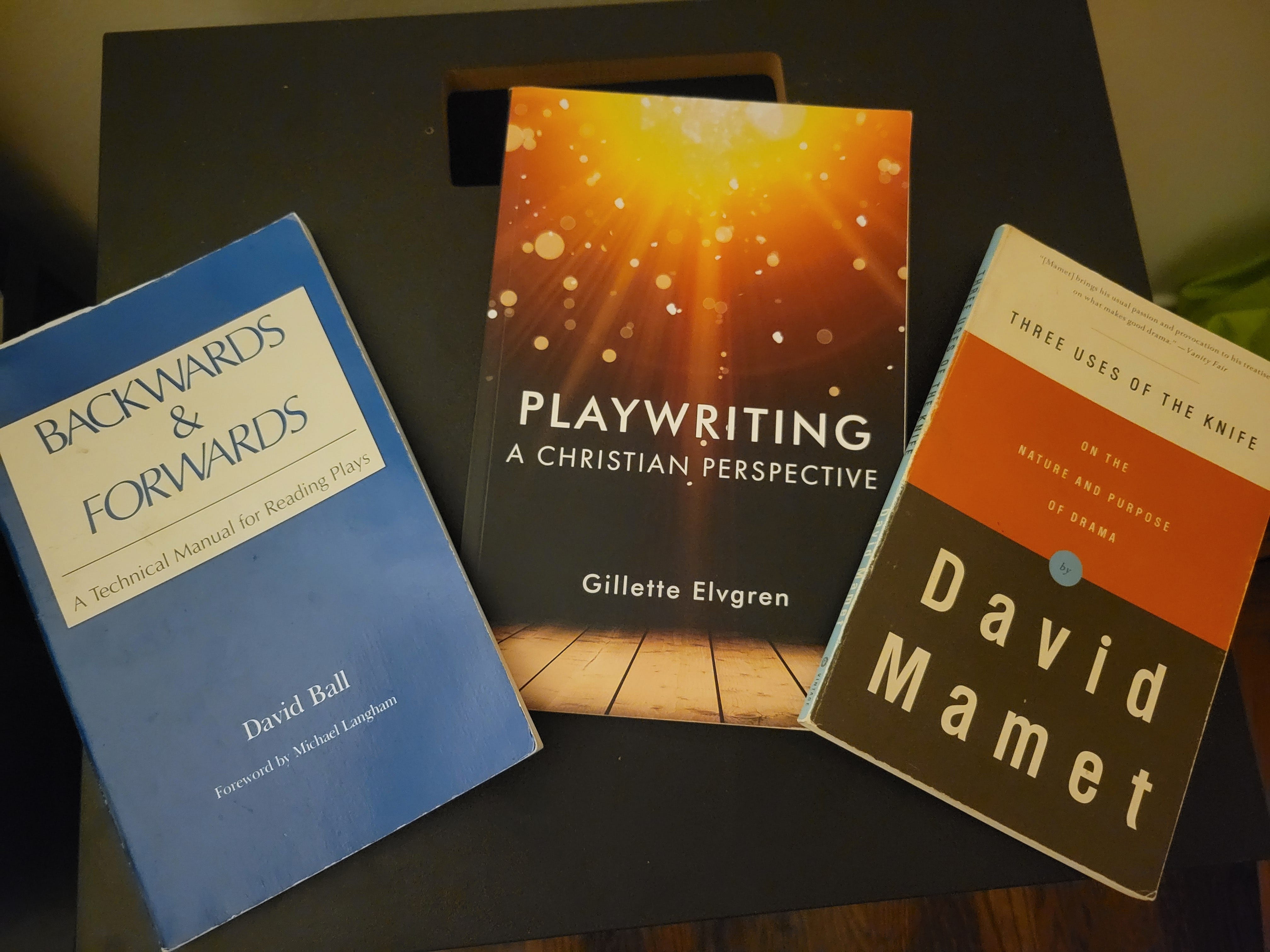
For books on playwriting, I’d recommend ‘Backwards and Forwards’ by David Ball, ‘Three Uses of the Knife’ (which tilts theoretical, but is still great) by David Mamet, and ‘Playwriting: A Christian Perspective’ by Gillette Elvgren (written for Christian college students, but super practical and helpful).
Until next time, I hope that’s some wind in your writing sails. Break a leg, and all the very best,
-Curtis
I quote from the Menthuen, London edition of ‘Glengarry Glen Ross.’ Page 3.
See Harold Pinter’s ‘The Homecoming’
If you’re watching the YouTube link, courtesy of Robert Cooperman and Stage Right, my play begins right before the 49 minute mark.
Great stuff, Curtis! I'm looking forward to your workshop at Vision, and this bit is a great start to get my brain chewing on the screenwriting format.
Thank you, Teddi! Glad its helpful and I'll see you there!
Looking forward.